
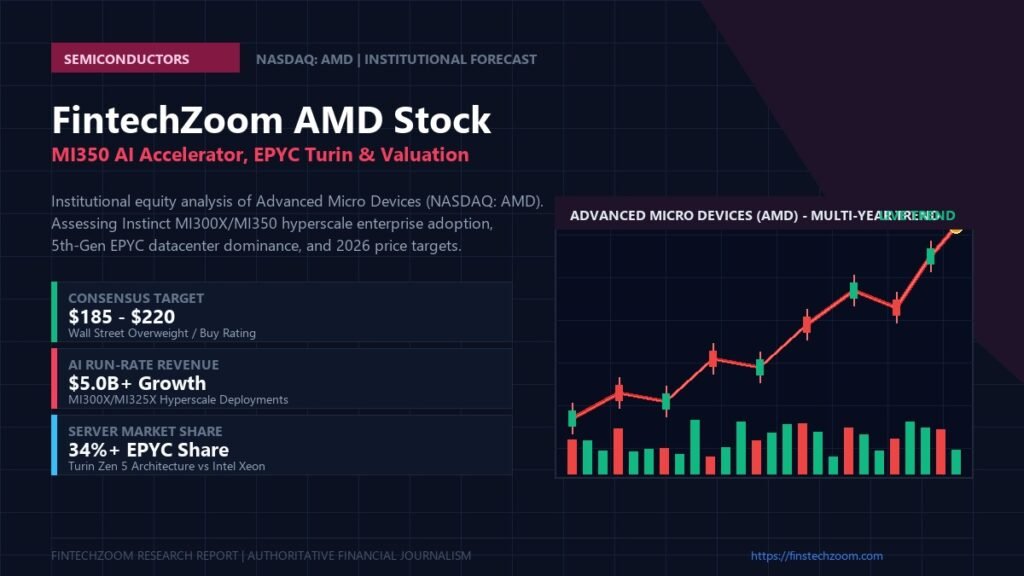
Navigating the semiconductor super-cycle requires a surgical understanding of datacenter compute economics, architectural innovation, and enterprise cash flows. On FintechZoom, our institutional market coverage tracks how Advanced Micro Devices (NASDAQ: AMD) has systematically transformed from an underdog CPU challenger into a Tier-1 titan commanding high-margin artificial intelligence clusters and enterprise cloud infrastructure. Led by CEO Dr. Lisa Su, AMD continues to execute on an ambitious roadmap designed to challenge traditional market dominance across datacenters, client computing, and high-performance accelerators.
Executive Metrics: Advanced Micro Devices (NASDAQ: AMD)
| Ticker / Primary Exchange | NASDAQ: AMD |
| Market Capitalization | ~$235 Billion – $248 Billion |
| 52-Week Trading Range | $116.04 – $227.30 |
| Consensus Forward P/E (FY2025/2026) | 28.5x – 31.0x |
| Datacenter Segment Growth (YoY) | +122% Record Pace |
| Instinct AI Chip Annualized Run-Rate | $5.0 Billion+ |
| Consensus 12-Month Target Range | $185.00 – $220.00 |
The Datacenter & AI Engine: Instinct MI300X, MI325X, and Beyond
The primary growth engine driving AMD’s equity valuation is its rapid market penetration within high-performance AI inference and model training clusters. Historically overshadowed by Nvidia’s dominant CUDA software stack, AMD has systematically narrowed the competitive gap through its CDNA 3 architecture and the open-source ROCm 6 software ecosystem.
The flagship AMD Instinct MI300X accelerator has emerged as a formidable alternative for hyperscalers seeking supply diversity and cost efficiency. Featuring an innovative 3D chiplet architecture with 192GB of HBM3 memory delivering up to 5.3 TB/s of aggregate memory bandwidth, the MI300X allows engineering teams to host massive Large Language Models (LLMs) like Llama 3 70B and 405B on single-node or smaller GPU clusters without excessive tensor parallelism overhead.
While our companion FintechZoom NVDA stock analysis highlights Nvidia’s commanding pricing power and full-rack GB200 NVL72 architectures, AMD offers hyperscalers compelling Total Cost of Ownership (TCO) advantages. Major cloud providers—including Microsoft Azure, Oracle Cloud Infrastructure (OCI), and tier-1 AI leaders like Meta Platforms—have actively deployed MI300X instances into core production workloads. Furthermore, the upcoming cadence of the Instinct MI325X (equipped with up to 256GB of ultra-fast HBM3E memory) and the next-generation 3nm MI350 CDNA 4 architecture establishes a viable multi-year product runway that keeps AMD at the cutting edge of enterprise AI acceleration.
EPYC Server Dominance: Turin (Zen 5) Squeezing Intel Xeon
While artificial intelligence graphics processors dominate financial headlines, AMD’s enterprise server CPU business continues to deliver massive, durable operating cash flows. AMD’s 5th Generation EPYC processor family (codenamed “Turin”), built upon the refined “Zen 5” and “Zen 5c” architectures, delivers up to 192 compute cores and 384 threads per socket on advanced TSMC process geometries.
Industry server data confirms that AMD’s server market unit share has crossed 34%, with revenue share approaching nearly 38% among global hyperscalers. Enterprise CIOs facing strict datacenter power and rack footprint constraints are aggressively decommissioning aging legacy servers and replacing them with high-density EPYC nodes. This server refresh dynamic enables enterprise customers to cut power consumption by over 40% while quadrupling virtualization compute density—a critical metric in power-constrained modern datacenters.
Client Computing & Edge: Ryzen AI 300 “Strix Point”
In the client computing segment, AMD has seized leadership in the emerging AI PC category with its Ryzen AI 300 Series processors (codenamed “Strix Point”). Integrating the “Zen 5” CPU cores, RDNA 3.5 graphics, and a dedicated XDNA 2 Neural Processing Unit (NPU) delivering up to 50 TOPS of dedicated INT8 compute, AMD comfortably exceeds Microsoft’s Copilot+ hardware requirements.
This technological edge has insulated AMD from broader consumer PC weakness, allowing it to capture higher average selling prices (ASPs) across premium commercial notebooks and thin-and-light creator laptops. Although semi-custom gaming console revenue (PlayStation 5 and Xbox Series X/S) is experiencing natural cyclical tapering late in the hardware cycle, expansion in commercial enterprise PC shipments and high-margin AI processors provides robust structural counterbalance.
Financial Health & Balance Sheet Resilience
A rigorous review of AMD’s balance sheet reveals exceptional structural health following the full digestion of the Xilinx acquisition:
- Gross Margin Trajectory: Non-GAAP gross margin has expanded toward 53.5%–54.0%, propelled by the rapid shift in revenue mix toward high-margin EPYC server CPUs and Instinct datacenter accelerators.
- Free Cash Flow (FCF) Generation: Trailing 12-month free cash flow has rebounded decisively, providing management with ample flexibility to fund aggressive R&D expenditures (exceeding $6.0 billion annually) and opportunistic share repurchases.
- Clean Capital Structure: AMD maintains minimal long-term debt relative to its liquidity, boasting over $4.5 billion in cash, cash equivalents, and short-term liquid investments, yielding a negligible net leverage profile.
Wall Street Price Targets & Scenario Analysis (FY2025 – FY2026)
Equity research desks across Wall Street maintain an overwhelmingly constructive stance on NASDAQ: AMD, with median 12-month price targets clustering between $185.00 and $220.00 per share. To help market participants model potential outcomes, FintechZoom evaluates three distinct fundamental scenarios:
| Scenario | Probability | Projected FY26 EPS | Target Multiple | Target Price |
|---|---|---|---|---|
| Bull Case | 25% | $6.50 – $7.00 | 32x – 35x | $225.00 – $240.00 |
| Base Case | 55% | $5.20 – $5.60 | 30x – 32x | $185.00 – $195.00 |
| Bear Case | 20% | $4.00 – $4.40 | 24x – 26x | $130.00 – $140.00 |
Bull Case Drivers: Datacenter AI accelerator revenue surpasses $8.0 billion as ROCm achieves broader open-source enterprise parity; Turin CPU share exceeds 40%; enterprise PC upgrade cycle triggers multi-quarter double-digit client revenue expansion.
Base Case Drivers: Datacenter AI revenue tracks steadily at $5.5B–$6.5B; EPYC maintains steady market share gains against Intel; client segment performs in line with seasonal trends; semi-custom console declines are managed predictably.
Bear Case Risks: Hyperscaler capital expenditure moderation slows AI infrastructure deployment; software lock-in reinforces CUDA loyalty among developers; competitive pricing pressure in enterprise CPUs compresses operating margins.
Technical Analysis & Institutional Liquidity Levels
From a technical charting standpoint, AMD stock has carved out a broad institutional accumulation base following pullbacks from its prior all-time highs above $227. Crucial technical levels to monitor include:
- Primary Support Zone ($138.00 – $142.50): This region aligns with the long-term 200-day Exponential Moving Average (EMA) and heavy volume profile point of control (VPOC). Institutional buyers have consistently defended this liquidity pocket during broader market pullbacks.
- Intermediate Resistance ($168.00 – $175.00): The 50-day moving average and former horizontal breakdown level act as short-term supply overhang. A confirmed weekly close above $175 on expanding volume signals a high-conviction breakout toward the $200 psychological barrier.
- RSI Momentum: Weekly Relative Strength Index (RSI) readings hovering near the neutral 48–52 corridor indicate that previous speculative froth has reset, creating attractive risk-reward conditions for strategic swing positioning.
Investor Takeaway: How to Approach AMD Stock Today
Advanced Micro Devices presents an exceptional blend of defensive core profitability and aggressive secular growth exposure. While Nvidia remains the undisputed leader in specialized AI supercomputing clusters, AMD represents the single most viable commercial challenger with the engineering scale, silicon architecture, and hyperscaler relationships needed to capture significant market share.
For long-term growth investors, dollar-cost averaging into support zones between $140 and $155 provides attractive exposure to the multi-trillion-dollar artificial intelligence and datacenter modernization cycle. For institutional risk management, maintaining a balanced semiconductor basket pairing AMD’s accelerating datacenter growth alongside broader hardware leaders remains a favored Wall Street playbook.
Frequently Asked Questions (FAQ)
What is FintechZoom’s consensus 12-month price forecast for AMD stock?
FintechZoom’s institutional consensus models project a 12-month base target of $185.00 to $195.00 per share, with an aggressive bull-case ceiling of $225.00 driven by accelerating Instinct MI300X/MI350 datacenter GPU adoption.
Can AMD effectively compete against Nvidia in enterprise AI?
Yes. While Nvidia retains an architectural lead in software integration via CUDA, AMD’s Instinct MI300X offers substantial memory bandwidth and memory capacity advantages at competitive pricing, winning major production deployments across Microsoft Azure, Meta Platforms, and Oracle Cloud.
How does AMD’s EPYC server CPU line impact its profitability?
AMD EPYC processors carry operating margins significantly higher than consumer hardware. As AMD captures over 34% of enterprise server market share, these server sales directly drive gross margin expansion toward 54% and sustain robust free cash flow.
Does AMD stock pay a dividend?
No. Advanced Micro Devices prioritizes capital reinvestment into research and development (over $6 billion annually) and programmatic share repurchase authorizations to maximize long-term shareholder equity value.