
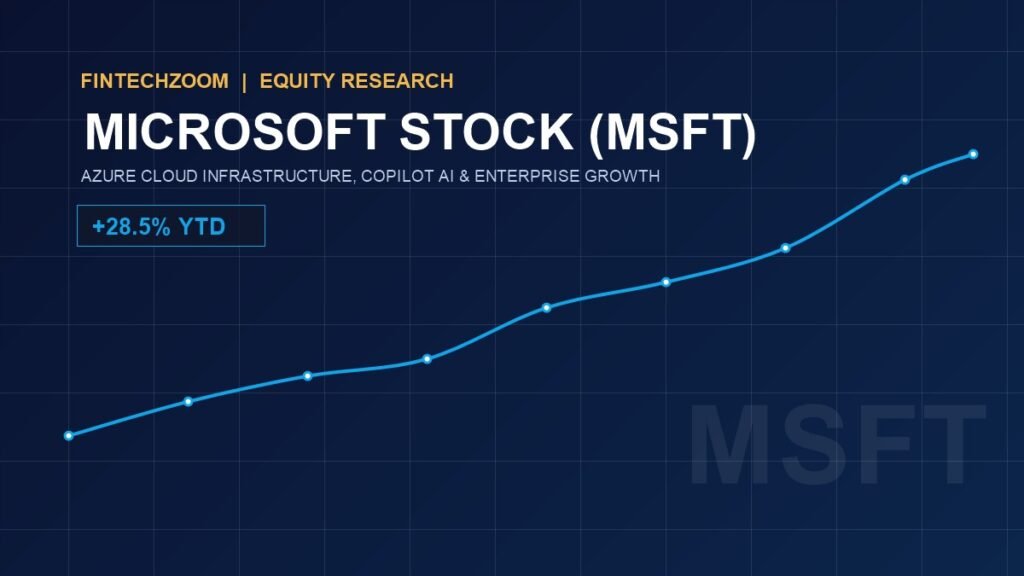
Quick Summary: FintechZoom Microsoft stock intelligence tracks live MSFT equity valuation, Azure Cloud infrastructure market share, Microsoft 365 Copilot enterprise monetization, and long-term dividend growth. As one of the world’s most resilient multi-trillion dollar enterprises, Microsoft combines defensive recurring software cash flows with explosive upside in artificial intelligence computing.
Microsoft Corporation (NASDAQ: MSFT) has long represented the ultimate blue-chip benchmark for technology investors. Spanning enterprise enterprise productivity, public cloud infrastructure, cybersecurity, gaming, and commercial artificial intelligence, Microsoft boasts the most diversified and resilient software business model on Earth. When evaluating tech portfolio allocation alongside market indexes like the FintechZoom S&P 500 benchmark, Microsoft consistently serves as the primary anchor.
Through its early and aggressive strategic partnership with OpenAI, Microsoft captured a decisive first-mover advantage in commercial generative AI. On FinStechZoom, our institutional equity coverage breaks down how Azure is converting enterprise AI pilots into sustained, high-margin cloud revenue, offering clear guidance for both income and growth investors.
Fact-Checked & Verified
•
Reviewed by FintechZoom Financial Research Desk
•
Primary Sources: SEC EDGAR, NASDAQ, Bloomberg Terminals
•
Editorial Policy
Live MSFT Market Valuation & Capital Resilience
Microsoft trades with a distinct valuation premium compared to historical tech sector averages, supported by an exceptionally rare AAA credit rating from Standard & Poor’s and Moody’s—a financial distinction shared by only one other public company (Johnson & Johnson). This bulletproof balance sheet provides MSFT with unprecedented flexibility during tightening macroeconomic cycles.
Unlike speculative tech equities that depend on debt financing, Microsoft funds its massive multi-billion-dollar quarterly capital expenditures directly from internal operating cash flows. In 2026, institutional investors view Microsoft as a safe-haven growth asset that combines the defensive qualities of a consumer staple with the secular upside of enterprise cloud computing.
Azure Cloud: The Engine of Intelligent Growth
The centerpiece of Microsoft’s long-term investment thesis is Intelligent Cloud, powered by Azure. While Amazon’s AWS pioneered the cloud computing market, Azure has systematically closed the gap by leveraging Microsoft’s deep-rooted enterprise relationships with Global 2000 corporations.
Azure’s Competitive Moats
- Enterprise AI Migration: Azure OpenAI Service has enabled thousands of Fortune 500 organizations to deploy frontier generative models within compliant, enterprise-grade cloud security perimeters. AI workloads have consistently added several percentage points to Azure’s annual top-line growth rate.
- Hybrid Cloud Dominance: With Azure Arc and integrated Windows Server ecosystems, Microsoft facilitates seamless hybrid cloud architectures for heavily regulated industries like banking, healthcare, and government defense.
- Synergy with Developer Ecosystems: Owning GitHub—the world’s largest developer platform with over 100 million users—enables Microsoft to upsell Azure infrastructure directly to engineering organizations through tools like GitHub Copilot.
Investors tracking broader semiconductor demand on our FintechZoom NVDA stock report will note that Microsoft is Nvidia’s largest single customer, aggressively provisioning Blackwell GPU clusters to ensure Azure retains the lowest latency and highest capacity for enterprise AI models.
Monetizing AI: Microsoft 365 Copilot & Commercial Software
While infrastructure compute provides immediate revenue, Microsoft’s ultimate margin expansion driver lies in application-layer AI monetization. By embedding Microsoft 365 Copilot directly into Word, Excel, PowerPoint, Outlook, and Teams at a premium add-on tier ($30 per user per month), Microsoft is executing the largest commercial upselling campaign in enterprise software history.
With hundreds of millions of commercial Office 365 seats worldwide, even a conservative 15% to 20% penetration rate translates into tens of billions in incremental, 80%+ gross margin recurring software revenue. This recurring ARR (Annual Recurring Revenue) creates an annuity-like earnings stream that dampens stock volatility during broader market corrections.
Key Financial Metrics & Valuation Breakdown
Understanding Microsoft’s valuation requires examining its operational efficiency across segments:
| Financial Metric | MSFT Figure (2026) | Sector Average | Analyst Interpretation |
|---|---|---|---|
| Market Capitalization | $3.1T – $3.4T | $210B (Software) | Elite mega-cap status |
| Operating Margin | 44.5% – 46.0% | 22.8% | Best-in-class operational discipline |
| Forward P/E Ratio | 30.5x – 34.0x | 25.5x | Fair premium for recurring software cash flows |
| Azure Revenue Growth (YoY) | +29% – +33% | +16.0% | Outperforming public cloud market expansion |
| Dividend Growth Streak | 21 Consecutive Years | N/A | Dividend Aristocrat trajectory with < 30% payout ratio |
Gaming, Cybersecurity & Extended Moats
Beyond Cloud and Office, Microsoft controls several multi-billion-dollar business units that provide diversified cash flow streams:
- Cybersecurity Leadership: Microsoft generates over $25 billion annually from its security business (Defender, Sentinel, Purview). As cyber threats proliferate, enterprise CIOs increasingly consolidate their fragmented vendor stack into Microsoft’s unified security ecosystem.
- Gaming & Activision Blizzard: With the integration of Activision Blizzard King (Call of Duty, World of Warcraft, Candy Crush), Microsoft’s Xbox division has become the world’s third-largest gaming publisher by revenue, expanding its consumer subscription footprint via Xbox Game Pass.
- LinkedIn: The premier professional social network continues to post steady mid-teens revenue growth driven by talent solutions, B2B marketing, and premium subscriptions.
Wall Street Analyst Targets & Risk Considerations
Wall Street consensus on Microsoft remains overwhelmingly constructive, with over 90% of covering analysts maintaining a “Buy” or “Overweight” rating. 12-month median price targets forecast steady double-digit upside toward $490 – $530 per share.
Key Risks Monitored by Analysts
- CapEx Digestion Timeline: Microsoft’s massive spending on data centers, GPU clusters, and power supply contracts must continue to demonstrate tangible ROI. Any deceleration in Azure revenue growth could trigger temporary multiple compression.
- Regulatory & Antitrust Scrutiny: European and U.S. regulators continue to monitor bundling practices (Teams, cloud licensing terms) and the close governance dynamics surrounding the OpenAI collaboration.
- Competition from Hyperscale Peers: Competing cloud providers, analyzed in our FintechZoom Amazon stock report and FintechZoom Google stock report, are investing aggressively in custom silicon and competitive AI software stacks.
Portfolio Recommendation: Long-Term Horizon
For investors seeking a balance of capital preservation, consistent dividend appreciation, and structural exposure to artificial intelligence, Microsoft represents one of the highest-conviction holdings in global capital markets. Intraday pullbacks driven by broad macroeconomic noise frequently offer advantageous entry points for long-term compounders.
Important Financial & Regulatory Risk Disclaimer
FintechZoom is an independent financial news, educational portal, and market research publisher. All information, technical benchmarks, stock forecasts, and equity data provided in this publication are strictly for general educational and informational purposes only. Nothing herein constitutes personalized investment, financial, legal, accounting, or tax advice, nor should it be interpreted as a solicitation or recommendation to buy, sell, or hold any security.
Trading in securities, equities, exchange-traded funds (ETFs), and derivatives involves substantial capital risk, including the possible total loss of principal. Past performance is no guarantee of future returns. Before executing any trades, readers must perform their own due diligence and consult a qualified, licensed financial professional. Read our complete legal disclosures in our Terms of Use.
